Why Toddler Attention Span Matters More Than Ever
In today’s fast-paced world, helping your child focus is one of the greatest gifts you can give them. Unfortunately, most modern solutions offer the opposite – flashcards, screens, noisy apps, and overstimulation.
But here’s the truth: You can build your toddler’s attention span without any of that.
In fact, at sharasa, we’ve found that focus isn’t taught through speed or repetition – it’s grown slowly, like a plant. Through rhythm. Through presence. Through curiosity.
If your child is between 1 and 6 years old, this is the window.
And the good news? You don’t need gadgets. You need intention.
What Is a Toddler’s Attention Span, Really?
A toddler’s attention span refers to how long they can focus on a single activity, toy, or interaction without distraction. For ages 2–4, the average span is around 4–8 minutes – but that can stretch to 15–20 minutes when nurtured properly.
And no, more screen time doesn’t help. In fact, studies show that frequent digital stimulation can shorten natural attention spans and increase emotional dysregulation.
So how do you build your toddler’s attention span in a healthy, developmentally appropriate way?
Let’s get into it.
How to Build Your Toddler’s Attention Span (The sharasa Way)
1. Create Daily Rhythms, Not Rigid Schedules
Children thrive on rhythm not control.
When your toddler knows what comes next, they feel safe. And safety increases focus.
Try this:
- Wake up → Story → Breakfast → Free play
- Post-lunch → Quiet time → Music → Outdoor play
This predictability reduces emotional spikes and increases the ability to stay with one activity longer.
2. Use Open-Ended Play (Not Flashcards)
Flashcards and “teaching toys” often close down a child’s thinking.
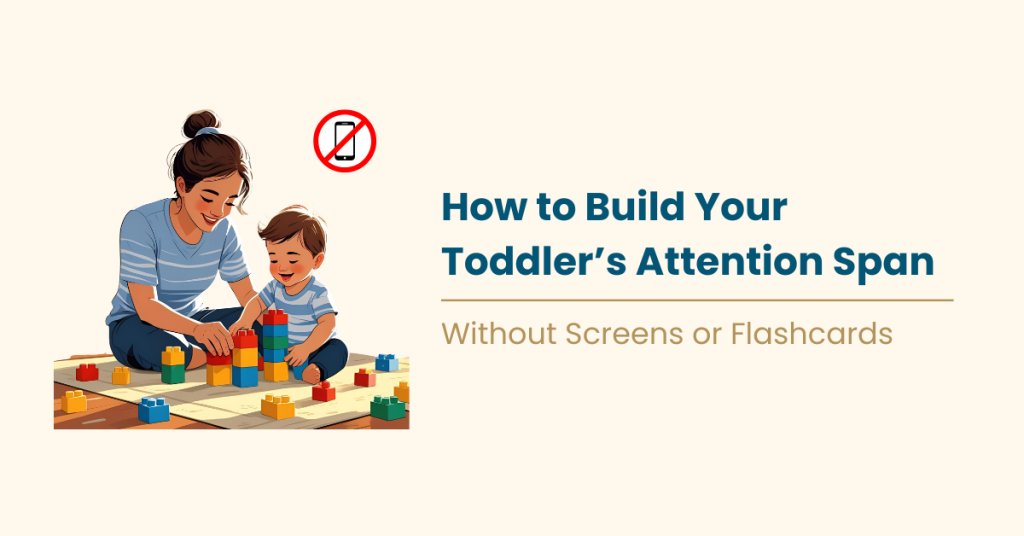
But open-ended materials like blocks, clay, nature items, and dolls invite deeper engagement.
Why it works:
- Your child becomes the creator (not just the receiver)
- They get absorbed in process, not just result.
This is how you build sustained attention without pressure.
3. Limit Background Noise
TV running in the background? Constant chatter? Fast music?
These drain a toddler’s focus.
Instead:
- Create quiet zones during play
- Use calm instrumental music during focus time
- Avoid multi-tasking while interacting
sharasa classrooms are intentionally designed with minimal sensory noise so children can tune in, not out.
4. Engage the Senses – Slowly
Sensory play builds focus when it’s slow and meaningful – not chaotic.
Examples:
- Pouring water into cups
- Transferring grains with a spoon
- Smelling spices
- Kneading dough
These activities calm the nervous system and build natural concentration – without screens or overstimulation.
5. Model Attention in Your Own Behavior
If your phone is in your hand while your child is talking – they learn that attention is optional.
Try this:
- Pause what you’re doing
- Make eye contact
- Reflect back what they’re doing
Your presence becomes their pattern.
At sharasa, we train our educators to model focused, slow engagement because that’s what toddlers mirror.
6. Use Cultural Tools That Center the Mind
Mantras, bhajans, simple hand mudras – these tools aren’t just spiritual. They build rhythm, breath awareness, and inner quiet.
At sharasa, we use:
- Simple bhajans for transitions
- Deep breaths with mudras before mealtimes
- Soft chants during circle time
This helps toddlers slow down and stay present, increasing their ability to focus on what’s in front of them.
7. Encourage Repetition (Yes, Again and Again)
If your toddler wants to stack the same blocks for the 20th time – let them.
Repetition is how toddlers build mastery. And mastery builds attention span.
sharasa Approach:
- We don’t rush from one activity to the next.
- We stay in the “boring” zone long enough for deep focus to emerge.
What to Avoid If You Want to Build Focus
- Constant switching of toys or apps.
- Fast-paced video content (even “educational” ones)
- Interrupting your child’s play too often
- Offering too much praise or reward (it breaks internal focus)
Instead, observe, join slowly, and let the moment expand.
Final Thought: Focus Isn’t Forced – It’s Grown
Building your toddler’s attention span takes patience, not pressure.
And it starts with replacing overstimulation with presence.
At sharasa, we’ve seen this magic unfold daily – as children go from distracted to deeply engaged, from scattered to centered.
If you’re ready to understand how your child is developing emotionally and intellectually, take the next step:
 Book a Free Assessment Session Today
Discover how your child learns best – and how to build focus naturally.