Why Indian Stories & Songs Matter for Emotional Growth
The role of Indian stories and songs in emotional growth isn’t just a cultural tradition – it’s emotional nourishment.
In today’s world of digital distractions and content overload, children are constantly bombarded by screens, fast-paced visuals, and overstimulation. But the early years – especially from 1 to 6 – are a sensitive window for emotional development. And in this window, nothing nurtures a child’s emotional world quite like a meaningful story… or a familiar song sung from the heart.
At sharasa, we’ve seen it firsthand. A child who’s anxious before class calms down the moment a familiar bhajan plays. Another starts opening up during story time, slowly learning to name emotions like joy, fear, or courage. It’s no coincidence – it’s brain science meeting cultural wisdom.
Emotional Development Begins Before Formal Learning
Before children can write alphabets or recite numbers, they must first learn something deeper: how to understand their emotions. Emotional development in early childhood forms the foundation for:
- Confidence and self-expression
- The ability to handle frustration and disappointment
- Developing empathy and social skills
- Emotional safety and self-regulation
And here’s the beautiful part – these life skills don’t come from a textbook.
They’re taught through tone, rhythm, voice, expression, and repetition – exactly what Indian storytelling and musical traditions offer.
The Emotional Science Behind Indian Songs
Indian music – especially lullabies, bhajans, and seasonal songs – plays a major role in shaping a child’s internal world.
- Lullabies like “Nindiya Aayi” or “Jhim Jhim Pavasala” aren’t just for putting a child to sleep. They create emotional safety, calm the nervous system, and offer the soothing reassurance of a parent’s voice.
- Bhajans bring spiritual rhythm and moral clarity. Singing “Raghupati Raghav” isn’t just a tradition – it’s a grounding tool that helps children build focus, calm, and connection.
- Festive songs like those during Diwali or Janmashtami help children feel a sense of joy, celebration, and cultural identity – all essential for healthy emotional growth.
💡 Did you know? Neuroscience tells us that rhythmic repetition helps children regulate emotions and strengthens their ability to process new experiences.
How Indian Stories Teach Emotional Depth
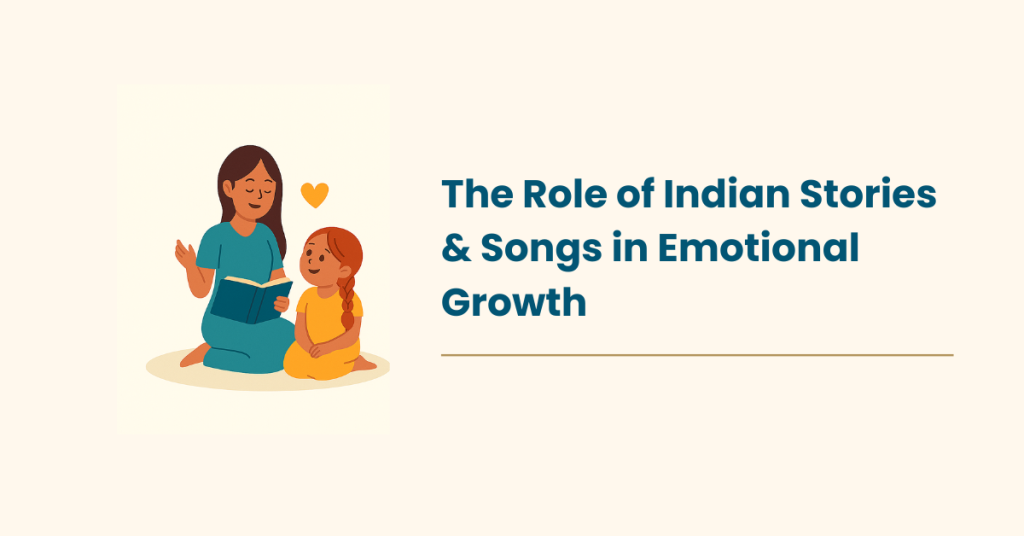
Let’s be honest – our grandparents were emotional educators long before we had the term “conscious parenting.” Through simple folk tales, they passed down wisdom through emotion.
- A brave rabbit.
- A clever crow.
- A loyal monkey.
- A wise king.
These characters weren’t just part of a bedtime routine – they were the first emotional guides for generations of Indian children.
Why does it work so well?
- Stories build empathy.
When children listen to characters facing emotions like fear, courage, sadness, or joy – they learn to name and understand those same emotions in themselves. - They improve moral reasoning.
A Panchatantra tale may end with “The lion learned to listen,” but what your child takes away is patience, curiosity, and consequence. - They build emotional vocabulary.
Words like brave, confused, hurt, or excited often appear in stories – giving your child the tools to speak what they feel.
At sharasa, we integrate storytelling not just during circle time, but across transitions – helping children regulate, express, and feel emotionally seen.
5 Emotional Benefits of Indian Stories & Songs
Here’s what children gain emotionally when storytelling and singing become a regular part of their environment:
- Better Self-Regulation
Repetition and rhythm calm the body, reduce meltdowns, and anchor emotional safety. - Increased Vocabulary for Emotions
Children begin to say, “I feel scared like the deer,” or “I’m happy like Ganesha.” - Deeper Parent-Child Bonding
Singing and storytelling are shared rituals – creating emotional closeness and trust. - Sense of Belonging & Identity
Cultural stories help children understand who they are and where they come from. - More Joyful Learning
Emotional growth isn’t a lesson – it’s a feeling. Stories and songs make that feeling fun, safe, and memorable.
sharasa’s Cultural & Conscious Approach
At sharasa, we don’t believe emotional education comes after academics – we believe it comes before.
That’s why our classrooms are designed to be:
- Story-rich, with folk tales, value-based fables, and interactive narration
- Music-based, with seasonal songs, chants, and lullabies.
- Emotion-aware, using stories to discuss feelings like frustration, sadness, or excitement
We follow traditional parenting methods blended with mindful parenting techniques, making sure children learn to feel before they perform.
This aligns with sharasa’s core belief:
“We don’t just prepare children for school. We prepare them for life – rooted in heart, culture, and self-awareness.”
Want to Start This at Home?
You don’t need to be a professional singer or storyteller. Here’s how any parent can nurture emotional growth using stories and songs:
- Pick 2–3 Indian folk tales or bedtime stories. Read them often.
- Sing one family bhajan or lullaby daily – your voice matters more than perfection.
- Ask your child how the character in a story might be feeling. Pause, let them think.
- Use songs to help with transitions – morning routines, meals, bedtime.
- Keep the rhythm light, joyful, and consistent.
Final Thought: Emotional Growth Happens in Moments, Not Modules
The role of Indian stories and songs in emotional growth is timeless – not because it’s old, but because it still works.
In the middle of modern parenting, these small cultural moments act like emotional roots. They hold your child steady, help them process big feelings, and grow into secure, curious, and kind human beings.
And the best part? It starts with your voice.
One line. One tune. One story at a time.
Want Guidance on Your Child’s Emotional Growth?
Join us at sharasa – where stories are sacred, songs are emotional tools, and every child is nurtured with presence, culture, and care.
🎁 Book a Free Assessment Session
🔗 Join the sharasa Parent Community
🌐 www.sharasa.in
📍 Indira Nagar & College Road, Nashik