In a world filled with flashcards, digital classes, and pressure to “keep up,” it’s easy to forget what toddlers truly need most. It’s not more alphabets. Not more information. Not more speed.
What they need is more connection.
At sharasa, we’ve seen this play out over and over again: When toddlers feel emotionally connected, they focus better, speak clearer, bounce back faster from challenges, and grow with confidence.
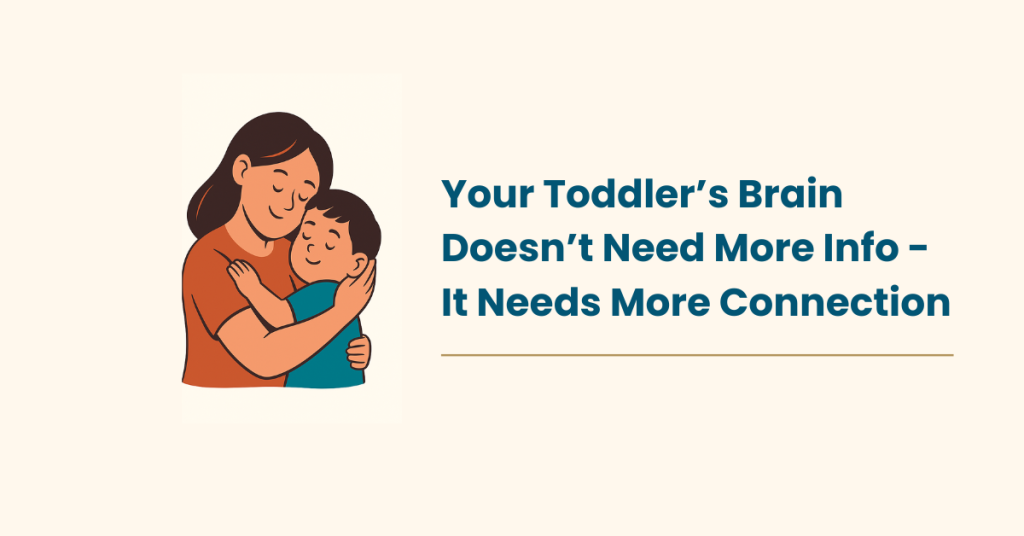
Because a toddler’s brain doesn’t need more info – it needs more emotional connection.
What Toddler Emotional Connection Really Means
Emotional connection is more than hugging or saying “I love you.” It’s about how seen, safe, and understood a child feels with you – even during tantrums, messy mornings, and “no” moments.
When children experience secure attachment, they know their feelings matter. They feel safe enough to explore, make mistakes, and come back for comfort when things get hard.
It’s in these moments of connection that brain pathways for emotional regulation, focus, and self-worth are formed.
A Story from sharasa: The Power of Feeling Seen
One morning, Aarav (3) was having a meltdown over a toy he couldn’t bring to class. Instead of rushing or correcting him, his teacher knelt, looked him in the eye, and said, “You’re feeling disappointed, right? You really wanted it.”
He paused. Then nodded through tears.
The outburst softened. His brain wasn’t told to “behave.” It was told, “You’re safe.”
That’s the magic of toddler emotional connection.
What Science Says: Connection Builds Brains
According to child psychology and neuroscience:
- A child’s prefrontal cortex (logic center) develops best when co-regulated by a calm adult.
- Emotional experiences, especially relational ones, strengthen neural circuits faster than academic input.
- Children who feel emotionally connected show better language development, problem-solving, and confidence.
Put simply: Children learn best when they feel emotionally safe.
Not when they’re corrected. Not when they’re flooded with facts.
6 Simple Ways to Build Daily Emotional Connection
You don’t need hours or special tools. You need presence. Here’s what connection looks like in everyday life:
1. One-on-One Attention (Even 10 Minutes Counts)
Turn off distractions. Get on their level. Make eye contact. Let your child lead the play or conversation.
Tip: One “yes” during play means fewer “no’s” later in the day.
2. Name the Feeling Before You Fix the Situation
Instead of “Stop crying,” say “You’re feeling frustrated, aren’t you?” This builds emotion vocabulary.
Emotional awareness begins with language. And naming calms the storm.
3. Use Rituals to Anchor the Relationship
Tiny daily rituals become emotional anchors. A special goodbye song, a bedtime chant, or even a high-five handshake.
These moments say: “I see you. I’m with you.”
4. Stay Regulated When They’re Not
Your calm is their compass. The goal is not to shut down the emotion – but to guide through it.
Toddlers borrow your nervous system to calm theirs.
5. Let Curiosity Be the Goal – Not Correctness
When your toddler asks “Why?” ten times, they’re not testing you – they’re testing the world.
Responding with wonder (not facts alone) builds emotional openness.
6. Apologize & Repair When You Mess Up
No parent is perfect. What matters is how we reconnect. “I was tired and I shouted. That wasn’t okay. Let’s try again.”
Apology teaches empathy, humility, and trust.
Emotional Connection vs Information Overload
Information-Heavy Approach | Connection-Based Approach |
Corrects behavior immediately | Understands the emotion underneath |
Focuses on results (“say sorry”) | Focuses on repair (“let’s talk about it”) |
Uses screens & worksheets early | Uses conversation, rhythm, and presence |
Measures success by milestones | Measures growth by trust, calm, and confidence |
sharasa’s Approach: Connection Before Correction
At sharasa, every child is more than a student.
They are a being to be nurtured – not just taught.
That’s why we:
- Offer low-ratio classes for real relationships
- Embed emotional literacy into storytelling and rituals
- Train educators to co-regulate, not control
- Use Indian cultural rhythms (chants, bhajans, rituals) as emotional anchors
- Prioritize bonding activities over academic drills
Because confidence, curiosity, and emotional safety grow from the inside out.
FAQs
Q: What’s the best way to connect with my toddler if I work full-time?
A: Focus on quality moments over quantity. Simple rituals like reading a bedtime story or chatting during a walk are powerful for connection.
Q: Can emotional connection reduce tantrums?
A: Yes. When children feel safe expressing their emotions, they don’t need to shout them. Tantrums become shorter and less frequent over time.
Q: Does emotional bonding help language development too?
A: Absolutely. When toddlers feel seen and heard, their brains are more open to learning and expressing with words.
Q: How can I teach boundaries without losing connection?
A: Use calm tone, explain simply, and stay firm but loving. Boundaries built with connection feel safe – not threatening.
Q: Can I use connection-building strategies with more than one child?
A: Yes – even small individual moments matter. Group connection rituals help too (songs, collective gratitude).
Final Thought
We’re not raising robots. We’re raising thinking, feeling, growing little humans.
Before your toddler can learn how to read or calculate – they need to feel connected. Safe. Seen. Held.
Because when a child’s heart is full of connection…
Their brain becomes a beautiful place to grow.
Want to Understand How Emotion Shapes Your Child’s Growth?
🎁 Book your Free Assessment Session at sharasa.
Let’s explore what your child needs emotionally – not just academically.
💛 Emotional safety starts with you. And we’re here to guide you.
🔗 Join the sharasa Parent Community
🌐 Visit: www.sharasa.in
📍 Indira Nagar & College Road, Nashik